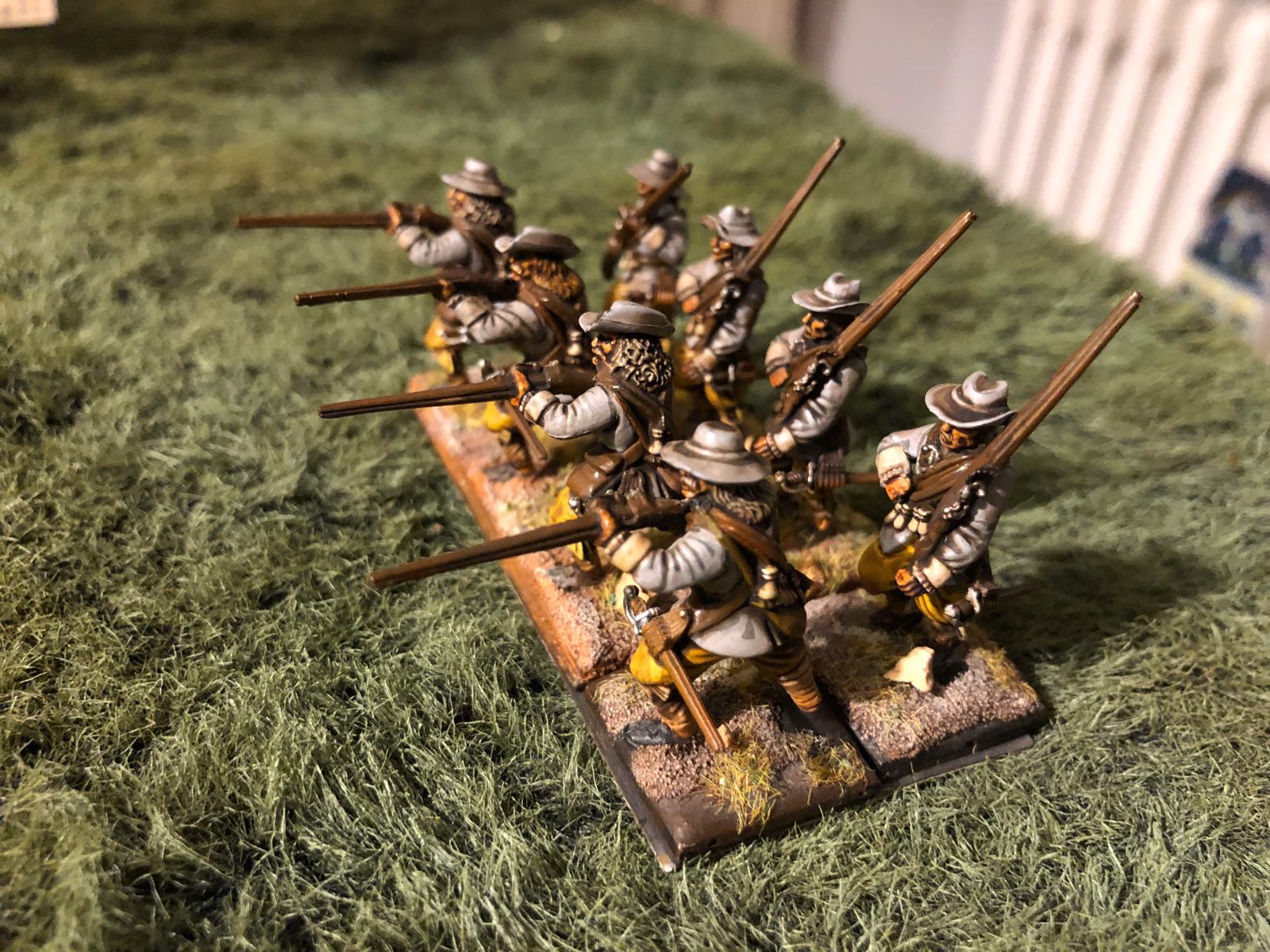
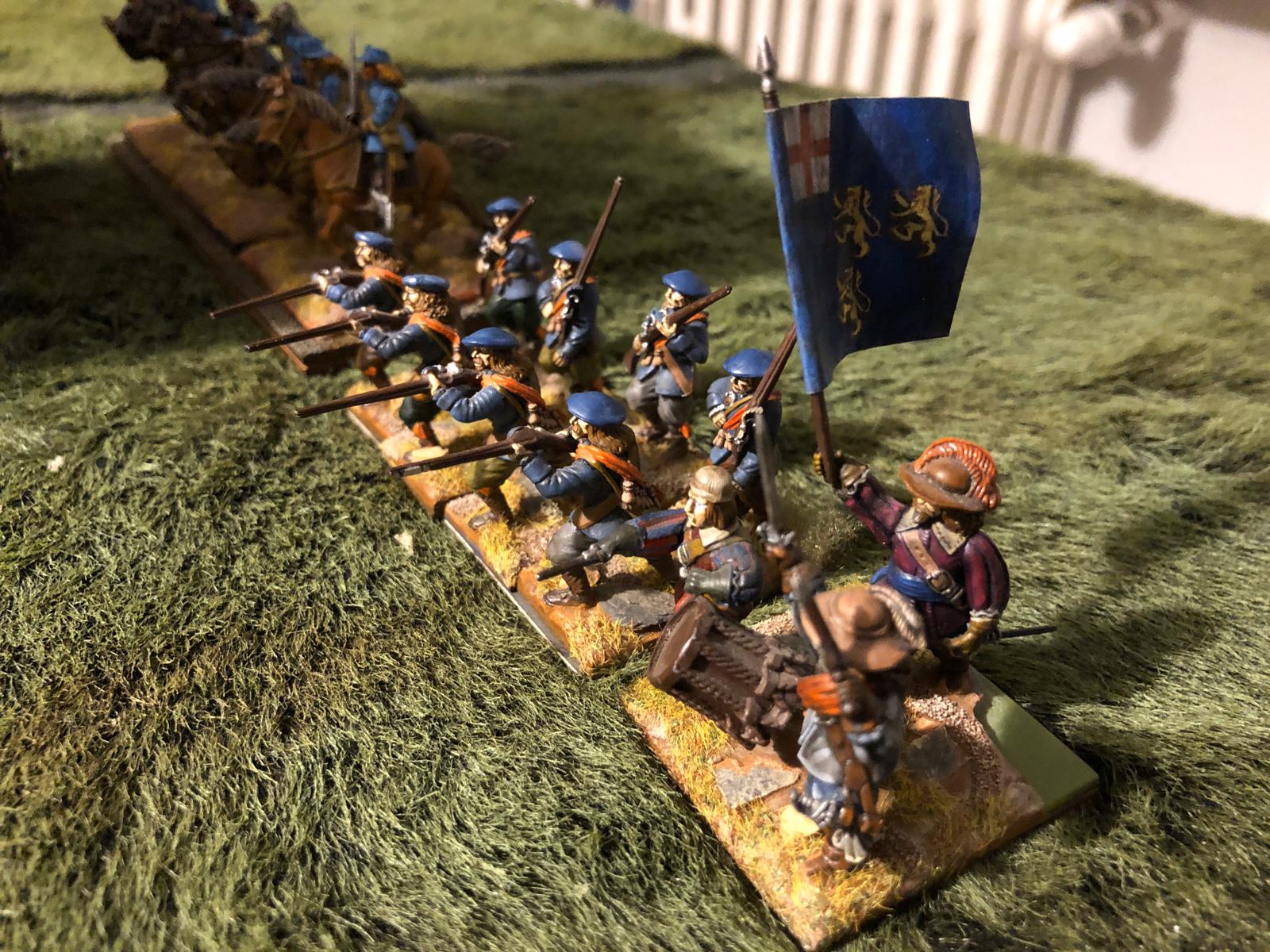
The Thirty Years' War has been ravaging Germany for years. Over the past winter, Swedish King Gustavus Adolphus skillfully employed diplomacy to strengthen the Protestant coalition, securing new allies against the Catholic Imperial forces. In particular, the Dutch Republic officially joined the war, bringing much-needed financial support and reinforcements to the campaigning Swedish army.
At the beginning of spring, the Protestant army marched south, prepared to confront the Imperial forces. The Imperials, determined to halt their advance, moved to intercept. Their armies would soon meet near the bustling market town of Messeburg, where a decisive battle loomed.
Initial Deployment
The Swedish army took position between the river and the village of Messeburg, anchoring its right flank with Protestant allied regiments of Dutch and Scottish troops under General De Vere, supported by dragoons commanded by Justinus von Nassau. The Swedish left flank was held by the cavalry, while in the center, a small reserve under Åke Tott stood behind the main infantry line.
The Imperial forces deployed strongly on their left flank, concentrating veteran tercios and their best marksmen in this sector. Their right flank, composed of heavy cuirassiers, was positioned beyond the river, seemingly preparing for an outflanking maneuver.
Early Skirmishes on the Left Flank
To counter the Imperial commanded shot in the wooded area on the Swedish left, the Dutch commander sent his mounted arquebusiers into the forest. However, their horses struggled with the rough terrain, and the Imperial troops managed to penetrate the woods, forcing the Dutch skirmishers to fight defensively with little success.
Stalemate in the Center and Right Flank
For much of the morning, the rest of the battlefield remained quiet. The Imperial troops stayed out of range of the Swedish artillery, while the Imperial cuirassiers on the right bank of the river showed no immediate intention of crossing. The Swedish cavalry took position on the opposite bank of the river, ready to strike if the enemy attempted to ford the waters.
Fierce Fighting for Messeburg
At the center of the battlefield, a brutal contest erupted for control of Messeburg village. Dragoons and commanded shot on both sides engaged in bloody street fighting, with the village changing hands multiple times. Only by the end of the day did the Swedish forces secure firm control over the settlement.
Åke Tott’s Failed Charge
Noticing a gap between the Imperial center and left flank, General Åke Tott led a squadron of demicuirassiers in a daring charge against the Imperial artillery. Despite initial success, the assault was repelled, and the Swedish cavalry was chased down by a squadron of Imperial dragoons hastily redirected from the fight in the village, momentarily relieving pressure on the besieged Protestant regiments.
Crisis on the Swedish Right
Meanwhile, on the Swedish right flank, the Dutch and Scottish mercenary battalions came under severe artillery fire, soon followed by volleys from the advancing Imperial tercios. Exposed in the open, the Protestant regiments suffered terrible casualties and began losing cohesion.
Gustavus Adolphus Takes Action
Realizing the precarious state of his right flank, King Gustavus Adolphus decided to order an advance of his Swedish infantry to stabilize the situation. The disciplined Swedish musketeers slowly moved into firing range, preparing to pressure on the Imperial right flank.
Imperial Assault on the Dutch and Scottish Regiments
Sensing the weariness of the Swedish right flank, the Imperial forces launched a full-scale assault on the battered Dutch and Scottish regiments. Despite their determination, the Protestant mercenaries suffered horrendous losses but held their ground at great cost, momentarily halting the advance, but on the brink of collapse.
Swedish Cavalry’s Bold River Crossing
In a desperate attempt to turn the tide, Gustavus Adolphus ordered his elite Swedish cavalry to ford the river and strike the Imperial right flank. The Imperial cuirassiers were caught off guard, and one squadron was routed at significant cost. However, the fighting along the river remained inconclusive, and the Swedish forces could not fully exploit their success due to the disarrangement they come after the perilious crossing.
Collapse of the Swedish Right Flank
Under relentless pressure, the Swedish right flank finally began to crumble, with two regiments breaking and fleeing. The Imperial forces pushed forward, threatening to roll up the entire Swedish line.
Tott’s Decisive Rear Attack
Meanwhile, Åke Tott regrouped his cavalry in the Imperial rear, having defeated the Imperial dragoons. He then launched a decisive charge into the rear of a struggling Imperial tercio, which was already wavering under fire from the elite Swedish Yellow Regiment.
Battlefield Stalemate
As the sun set, the battlefield was in a state of deadlock. The Swedish right flank was shattered, incapable of further combat. However, a significant gap had been opened in the Imperial center, with Messeburg in Swedish hands, effectively splitting the Imperial army in two. On the left flank, the battle between the opposing cavalry forces remained inconclusive, although reserves were still available to the Catholics. Although numerically disadvantaged and suffering heavier losses, the Swedish forces and their Protestant allies maintained control of the field and withdrew in good order, denying the Imperials a clear victory. The battle ended in a costly stalemate, with both sides bloodied and exhausted.


Final Comment
We played this game at Model Expo 2025 Convention in Verona with Liber Militum Tercios, 2000 points per side, 2 vs 2 players, in a 240 x 180 cm table! The game played smoothly over 5 hours. The Imperial ended with 2 points of advantage, which were not enough to declare a clear victory. Overall, we enjoyed the experience and many people stopped to ask and take pictures!