Visualizzazione post con etichetta Venice. Mostra tutti i post

domenica 13 luglio 2025

A Wargamer in Corfù

Corfù, the largest of the Ionian Islands, is steeped in history and offers a perfect opportunity to combine a family summer holiday with various wargaming inspirations.


Historical background

The island was once part of the Eastern Roman Empire (later known as the Byzantine Empire). During late antiquity, Corfù was raided by Vandals and Goths, while during the early medieval period, it was invaded by the Normans in 1084 during their failed attempt to conquer the Balkans. Following the Fourth Crusade, Corfu was assigned to Venice, which contested its control with the Despotate of Epirus and the Angevins. From 1386 onward, the Serenissima (Republic of Venice) maintained firm control of Corfu until its fall in 1797.

Separated from the Greek and Albanian mainland by a narrow strait only 3 to 25 kilometres wide, Corfu was a vital route for the Venetians to access their holdings in the Eastern Mediterranean. As the Venetian colonial empire declined, Corfu remained the gateway to the Adriatic Sea and served as the last major bulwark against Ottoman expansion, especially after the loss of the Morea in 1715.

In 1716, the island was the site of a memorable Ottoman siege. Thanks to the determination of the defenders, led by Count Matthias von der Schulenburg, and the concurrent Austrian victory at the Battle of Petrovaradin, this siege marked the last significant Venetian victory during the troubled final century of the Republic. We will explore this siege further in a future blog post.

Later, Corfu played a role in both World Wars: during World War I, it served as a refuge for the Serbian army, and in World War II, it became a base for Italian operations against Greece. After Italy’s capitulation on 8 September 1943, Italian troops stationed in Corfu and Cephalonia were attacked and massacred by their former German allies.


What to see

And now, on to the travel suggestions! Please note that I’ll be focusing exclusively on military-related sites—but keep in mind that Corfu offers a wealth of historical, artistic, and natural wonders beyond these.

The ruins of the early Christian basilica at Palaiopolis mark the location of the island’s original settlement, which was abandoned due to barbarian invasions and the instability of the 5th and 6th centuries AD. Some of the basilica’s frescoes and mosaics are preserved in the museum at the Old Fortress in Corfu Town. Alas, none of the military subject!

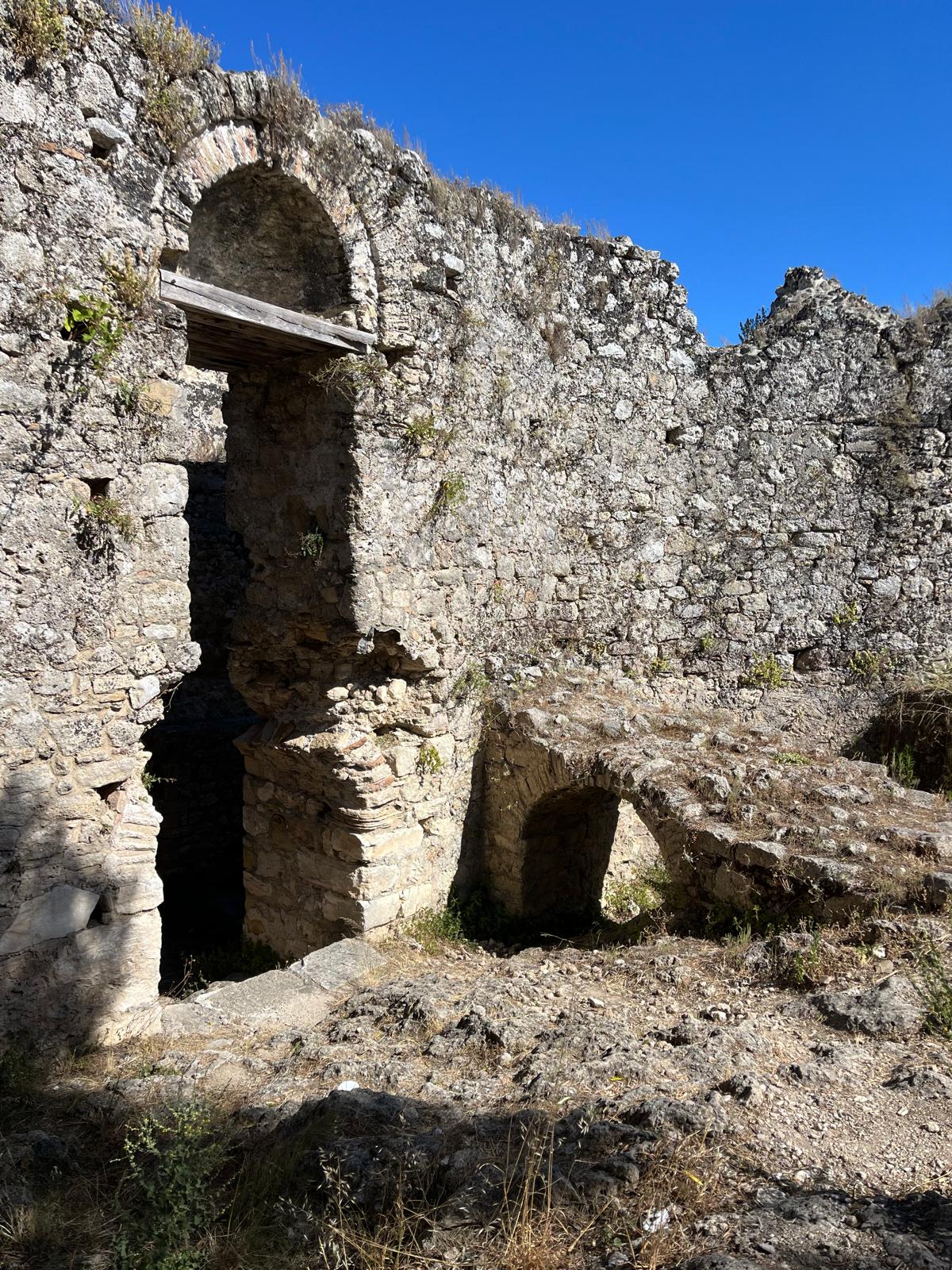
From the Byzantine period, visitors can explore the ruins of Angelokastro (Castle of the Angel), dramatically perched atop a hill overlooking the stunning beaches of Paleokastritsa (whose name, incidentally, means "Old Castle"). Located in the northern part of the western coast, the fortress was likely built under the Despotate of Epirus as a defence against Western powers such as the Venetians and Angevins. On the southeastern coast, the small castle of Gardiki dates to the same era. As of my visit in 2025, only the perimeter walls and a single gate remain, but they still give a clear impression of the site's original scale. See pictures below.




Moving to the Venetian period, in the North-East extremity, we have the fortress of Kassiopi: a former Byzantine fortress, later one of the main Venetian strongholds, allowing the control of the narrower tract of the strait. Below, the night view.


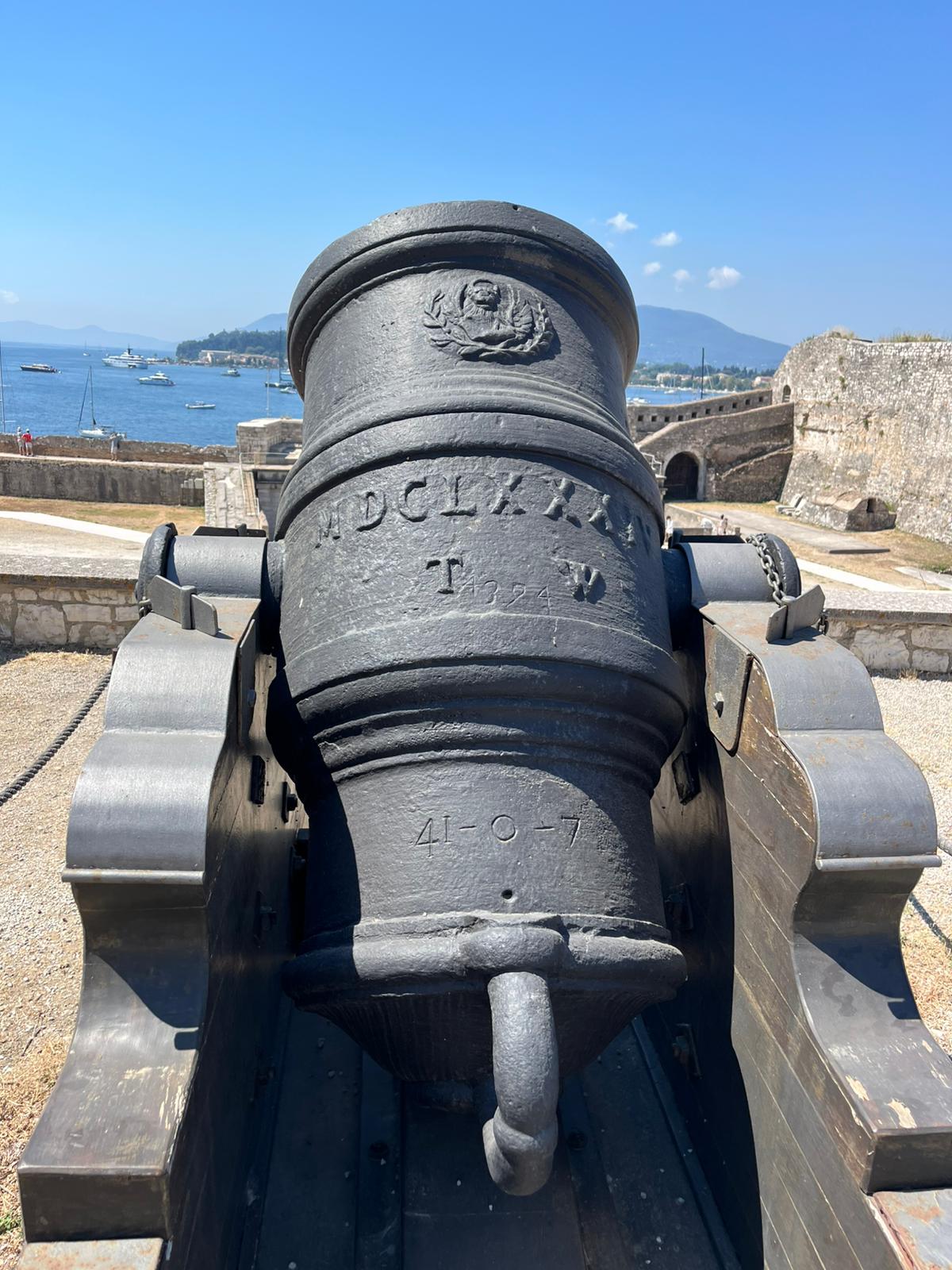
Moving to the capital city of Corfù, the Venetians built two fortresses: the Old Fortress (on the site of a previous Byzantine castle), is the main attraction of the city, and provides a perfect example of Venetian fortress in their colonial Empire, serving as a model for fortresses in other Greek islands and mainland. The bastions and the ramparts are perfectly preserved. Inside, there are some artillery guns from the late 17th - early 18th century and remarkable Venetian St. Mark lions. The new Fortress was built later, but still before the 1716 siege. Here are some pictures from the Old Fortress.



Next to the main gate of the fortress, you can also find the statue of von Schulemberg, the Saxon general who defended the island during the 1716 siege and represented the last victorious general in the history of Venice. Again, he deserves one his own post in the future.


According to the military precepts of the Age of Reason, Venice demolished the buildings in front of the Old Fortress to deny cover to any approaching enemy. Like many other features on the island, it still retains its Italian name Spianada (flattened space), similar to Verona's Spianà. This is the main square of Corfù. Funnily, exactly as in Verona, the marble pavement in front of it is called a liston.

I have to thank the page Il Viaggio di Scoperta, which in its last video shows more Venetian artefacts from Corfù... in the Tower of London! They were brought there after the Island became a British protectorate. For the curious, the video (in Italian) is here. I recommend the page to anyone passionate of Venice,

Lastly, in Gouvia, about 8 km north of the city, you can visit the remains of the Venetian arsenal. While it still deserves a visit, its conservation status is not great, and it is a shame because had a pivotal role in the naval power of Venice in the entire region, in particular again during the siege of the island: more naval wargamin opportunities!


For the moment, it is all, but as you can infer, there are many ideas which will be covered in future posts. So stay tuned!


giovedì 13 marzo 2025

Lion Rampant at Lazise Gioca: A Medieval Skirmish on Lake Garda

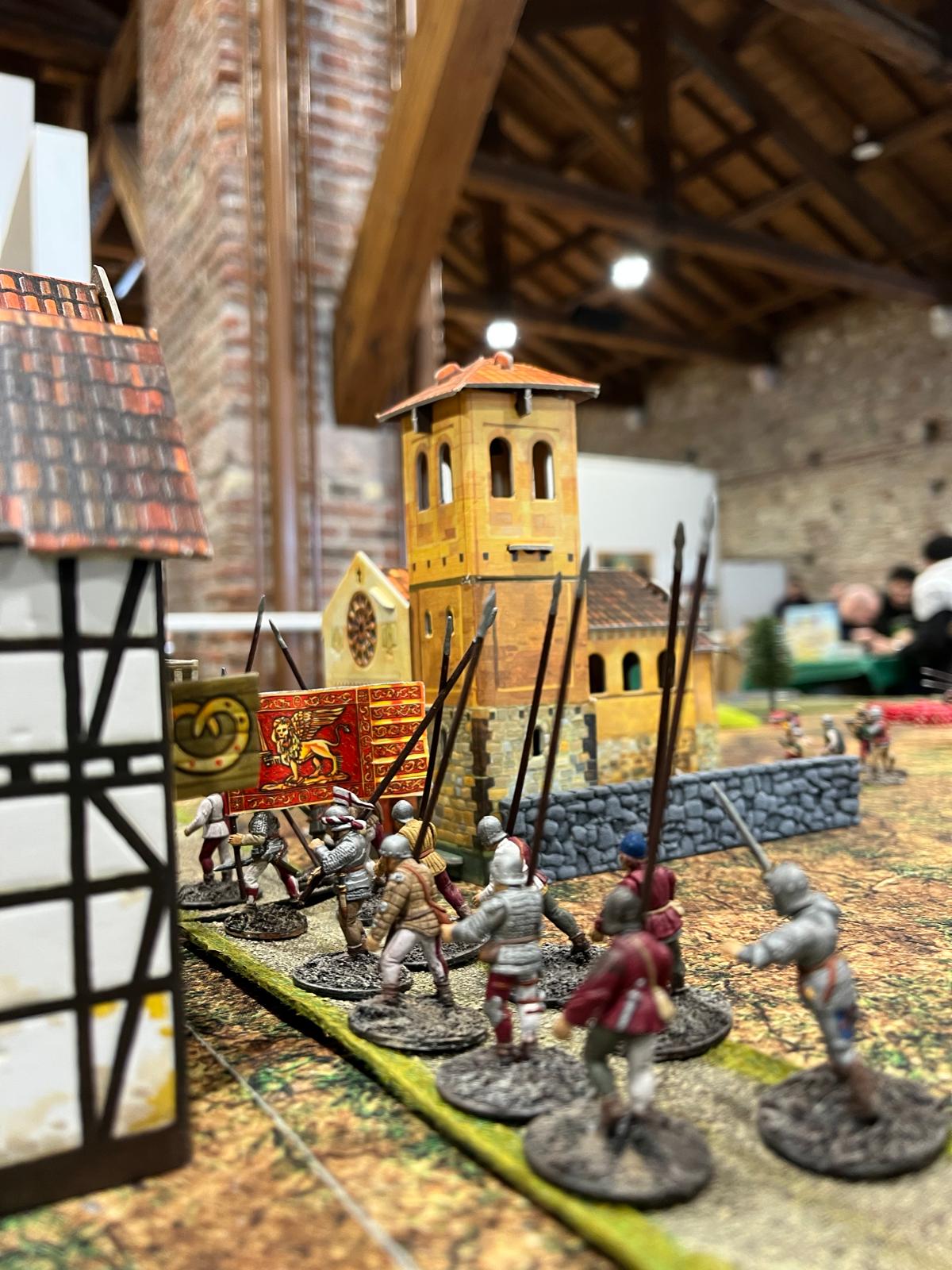
This past weekend, we had the pleasure of attending Lazise Gioca, a fantastic gaming convention held in the scenic town of Lazise, on the banks of Lake Garda (Verona, Italy). Among the many tabletop and board game offerings, we set up a historical wargaming table featuring Lion Rampant by Osprey, a fast-paced and engaging skirmish game perfect for conventions.

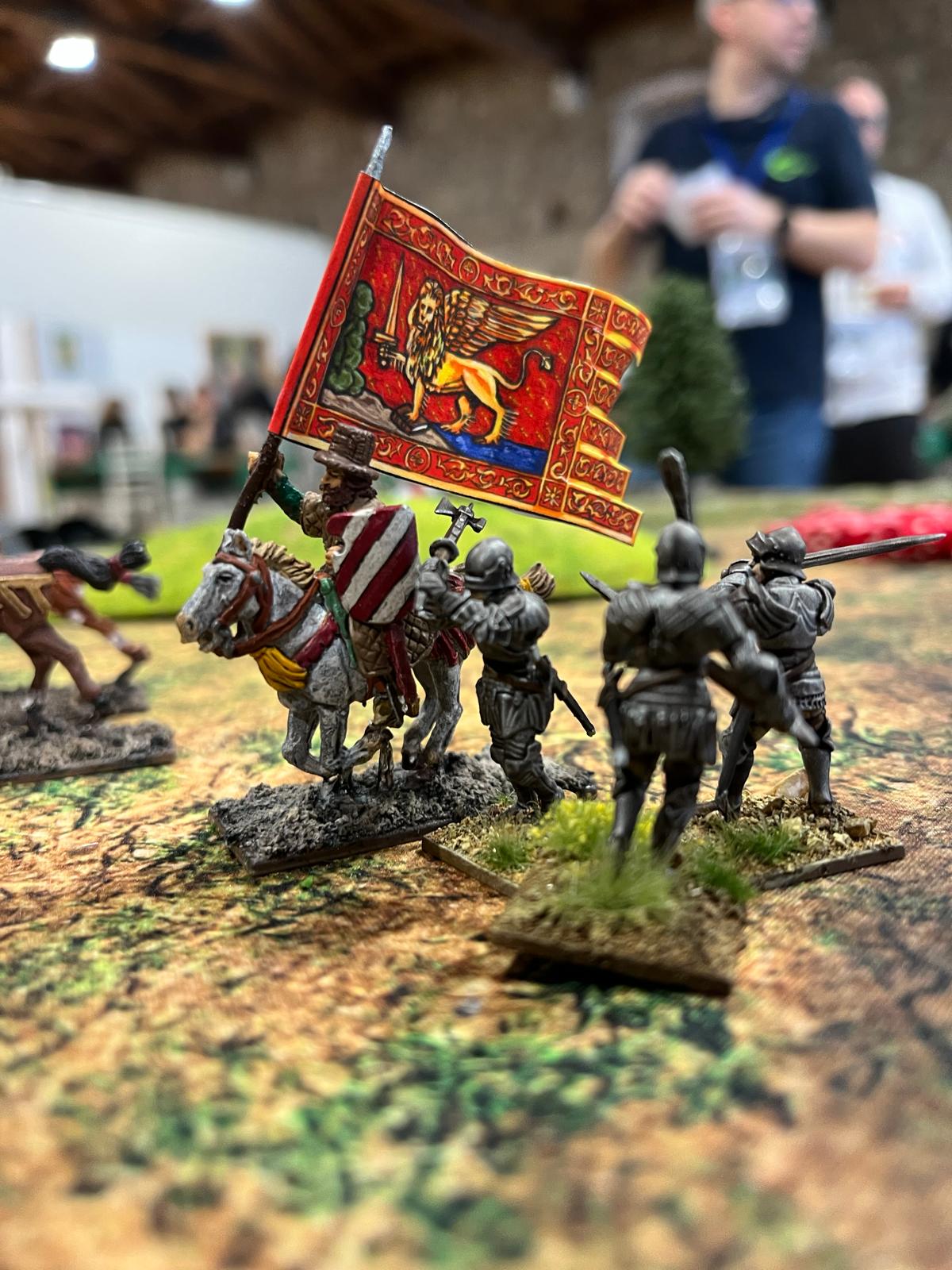
Since the lake Garda was a border region between Milan and Venice, we decided to bring two condotte  from the late 15th century: one representing Milan and the other Venice. Each force was built to the standard 24-point size, constructed mainly from Perry's plastic miniatures. Throughout the day, we managed to run two different scenarios.

The Battles

Our first scenario was Bloodbath, a straightforward clash where both sides sought to eliminate the other through sheer force of arms. It was a brutal and fast-paced engagement, with both condotte trading blows in a display of tactical maneuvering and daring charges. Despite the famed resilience of Venetian forces, the Milanese emerged victorious, securing a hard-fought win.

Next, we set up The Fugitive, a scenario centered around capturing (or rescue) a key figure hiding on the battlefield. The Milanese, emboldened by their earlier success, pressed the attack relentlessly and managing to free the prisoner. Once again, Milan’s condotta claimed victory!

A Great Experience

The event was a fantastic opportunity to showcase Lion Rampant and introduce new players to the world of historical wargaming. The game’s elegant mechanics and accessible rules made it a hit among both casual visitors and experienced gamers alike.

Overall, Lazise Gioca proved to be a fantastic convention, in an amazing setting, and we thoroughly enjoyed bringing late medieval Italy’s mercenary battles to life. 

Milanese foot men at arms fight Venetian stradiotti

The setting

The Venetian Cernide (foot yeomen in the ruleset) enter the village

The Heavy Cavalry clashes!

Milanese Crossbowmen: one of the major contributors to Milanese's victory

Stradiotti tries to held the line against the heavier Milanese's Lance Spezzate

Venetian Schioppetti are mauled by Milanese dismounted knights


venerdì 6 ottobre 2017

The blog name: Arsenale del Nano

What's in a name? 
(Romeo and Juliet, act II, scene II)

As some of you may have noticed, I recently changed the header of my blog, and I feel that's a good excuse to give to the (few) curious a short explanation about my blog's name, expecially for not-Italian speakers.
View of the Entrance to the Arsenal by Canaletto, 1732.


Arsenale

What's an Arsenale? "arsenal, armoury, dockyard", where weapons are stored and (sometimes) forged. Obviously my weapons are lead and plastic (and resin perhaps) soldiers and scenics, but also rulesets, scenics and terrain, painting and brushes, all that sort of stuff which keeps the bellic effort going. 

But Arsenale  was chosen also with a precise geographical reference in mind: Venice. The name Arsenale itself derives from this city, it's Dante Alighieri, the most famous Italian poet in his Divine Comedy to first use this term to describe Venice dockyard, comparing the boiling pitch used to mend the vessels during winter (a period in which navigation was suspended during middle ages) to the hell environment. For those interested in literature here's the full text, both in Italian and English.


As in the Arsenal of the Venetians
Boils in winter the tenacious pitch
To smear their unsound vessels over again
For sail they cannot; and instead thereof
One makes his vessel new, and one recaulks
The ribs of that which many a voyage has made
One hammers at the prow, one at the stern
This one makes oars and that one cordage twists
Another mends the mainsail and the mizzen

Thus, not by fire, but by the art divine,

Was boiling down below there a dense pitch

Which upon every side the bank belimed.
Quale nell'arzanà de' Viniziani
bolle l'inverno la tenace pece
a rimpalmare i legni lor non sani,
ché navicar non ponno - in quella vece
chi fa suo legno nuovo e chi ristoppa
le coste a quel che più vïaggi fece;
chi ribatte da proda e chi da poppa;
altri fa remi e altri volge sarte;
chi terzeruolo e artimon rintoppa -;
tal, non per foco ma per divin' arte,
bollia là giuso una pegola spessa,
che 'nviscava la ripa d'ogne parte.

(Dante, Inferno, XXI, 7-18)


The Lion

The symbol of the blog is going to be the Pireaues Lion, a statue located at the entrance of  Venice Arsenale, originally located in Athenes (Piraeus port), was taken in 1687 as plunder by Morosini during one of the various Turkish-Venetian wars. Probably it seemed pretty appropriate, since Venice symbol is a (winged) lion. The lion hides an additional history: at the end of 18th century a Swedish diplomat recognised a lindworm carved on the lion, probably by Varangian merceanaries sent by Costantinople to sedate a riot in Athenes during X-XI century. Nowadays the carvings are seriously deteriorated by pollution and time, but it's still intuible.


In conclusion, I felt that Arsenale and its Piraeus Lion are the perfect sintesis of the many instersections of histories represented by wargaming, the site where armies and weapons were assembled and where many glorious (and bloody) deeds had their beginning.

...and Nano?

Oh, that's just a nickname my girlfriend gave me at the beginning of our relationtship. It means dwarf in Italian, since I'm only 1.65 metres tall ...and she's 1.76! (Incidentally it's also my grandfather nickname, but as a shortening of Giordano).