Visualizzazione post con etichetta Review. Mostra tutti i post

lunedì 4 gennaio 2021

Osprey "Renaissance Armies in Italy 1450 - 1550" review

I just received the recently published Osprey Men-At-Arms 536 "Renaissance Armies in Italy 1450 - 1550". The book presents the usual MAA format and it is tightly packed with historical information, uniformologic details and beautiful illustrations.


The author is G. Esposito, and the booklet is preciously illustrated by the skilled G. Rava, one of my favourite historical illutrators.

You can find details about the main armies of the periods, both Italian (Milanese, Florentine, Papal, Venetian, Kingdom of Naples) and Foreign (Aragonese, French, Imperial German). The illustration are well researched (the commentary plate is one of the most valuable asset of this series), and very inspiring (for those interesting seeing them translated into the wargaming table, check my post). The book also contains other illustrations, also in colour (differently from older Ospreys), but in this volume mostly from the same source/style, I would have preferred a little variation and some real piece of armour, instead than nineteenth century impressions.

Lastly, the book share the the same issues as the previous books about Italian history (e.g. Italian Medieval Armies 1125–1325 and Italian Unification Wars): too much events and armies in the frametime and to little space to deal with them! I understand the limitation imposed by the series format, and I think the author managed to squeeze the essential in it. For this reason I would have loved a longer bibliography, which is instead limited to a couple of volumes for each army involved.

Overall I value positively the book, mainly for its illustrations, for many player it will be a nice introduction to this period.

Images taken from author Facebook page for his concession.


domenica 10 febbraio 2019

Rebels and Patriots, first AAR

First game and first thoughts with Rebels and Patriots, Osprey Wargames last rules by Michael Leck and Daniel Mersey.
Rules took definitely a lot from Rampant mechanics, but most of all from Rampant mentality: they aim to provide a fast fun game, both cinematic and historically plausible, through reflecting the ebb and flow of the 18th to 19th century warfare without dealing with a lot of minutiae.
Quick insight: they succeed in giving me the feeling of being a company commander of the period, without sinking me in a lot of details to remember. 
If you're looking for a ruleset with lot of tables for different weapons this could not be your first choice, but probably you'll missing a lot of fun.


Since my Risorgimento miniatures aren't painted yet,  I used Franco painted 1/72 Napoleonic figures to test the rules. We deployed a French and a English company.

English 24 points

Line Infantry x2 @8 points
Light Infantry (Rifles) @6 points
Shock Infantry (Highlander) @6 points
Light Cavalry (Scot Greys scouting) @4 points

French 24 points

Line Infantry x2 @8 points
Light Infantry (Voltigeurs) @6 points
Light Infantry (Dragoons scouting) @4 points
Light Artillery @ 4 points
Skirmishers @2 points

English (commanded by Franco) used the terrain better: their cavalry hidden behind woods and charged against formed Voltigeurs. They inflicted a lot of casualties (4), but Voltigeurs didn't faltered and the following turn delivered a deadly volley against the cavalrymen, who ran away.


On the other side, French failed to cover decently their Dragoons behind the woods, taking some silly casualties from English Riflemen. French artillery was deployed over one hill, but failed to contribute in a significant way.


The battle revolved around the central hill, quickly occupied by the English infantry, but French failed at dislodging them. Franco was pretty aggressive, ordered his highlander to charge downhill (BTW being uphill only provide bonus during defense): they destroyed one French line infantry taking only light losses.


They engaged and badly hurted a second infantry unit the following turn, but this time they were repelled in disorder. At this points French Dragoons (hidden better behind the woods) took the moment and charged the Highlander routing them.


Despite this French were soon in such a bad array any more offensive was impossible for them. Luckily the game ended before the last two English unit (both without any significant loss) can reach them.

Probably a lot of mistakes was made, but a lot of fun was had too, overall the game flowed well (and I just read the rules once).


Some thoughts from the first game:
  • Cavalry, even if light, charging formed infantry in good order may (if it can avoid being shot ) inflict heavy losses, nonetheless cavalry seems to be a one shot weapon against good order infantry, lacking staying power.
  • It's very useful to place a lot terrain, particularly fence and other light covers and not just broken terrain and woods. This would help reducing shooting deadliness.
  • Shock infantry may be very powerful in attack: combining first fire, charging, being in close  can bring the needed score to hit the enemy a 2+, pretty deadly!
  • Morale tests influenced only by last action losses helps making unit less fragile and stay in game for more turns despite greater casualties rate from firing. I found the morale and order test well thought, overall.
  • The game turn continuing after a failed activation has been a very welcomed news. So did the casual charge movement, very well integrated in the order system.
  • The officer are more useful now, but I had like more Officers being separated from their "guard unit", since when inside infantry they're quite slow and looks more like sergeants than colonels, but just my opinion and shouldn't be too hard to house rule.
Eventually I think Dan and Michael succeed in create a ruleset easily adaptable to European theater from Seven Years War to French Prussian War, encopassing a lot of (to me) interesting conflicts. I'd resist the urge to buy lots and lots of miniatures! 


domenica 27 gennaio 2019

Takenoko and Ticket to Ride - Europe


I recently tried two new boardgames, somehow similar: Takenoko and Ticket to Ride - Europe, and here's a brief review.

Takenoko

A panda, a farmer and the Emperor.
Performing actions (usually 2 per turn) like on placing terrain tiles or water channels, move the farmer (who grows the bamboo), and the Panda (who eats the bamboo), you've to achieve your missions which can be: arrange the terrain in peculiar ways, have a certain number of bamboo pieces on a certain number of tiles or have a certain number of bamboo pieces in your panda stomach.

The rules are quite simple, each player has a summary sheet with the actions available each turn, only some cards can be a bit confusing (no text on them, nor in the summary sheet - so totally language independent, once you know the basic rules). Every player plays his game, aiming towards his/her secret goals, given by the objective cards. The interactions between players is totally indirect: you manipulate the same terrain, panda and farmer using them for different things! At the beginning of the game this really hampers other players strategies, but later in the game the effect was far feebler.

The cons of the game is that beyond half the game, many new objective cards you draw (drawing objective cards is an action) can be easily achieved with few actions or later in the game with no actions at all, since you already find on the table the conditions you need to reclaim the goal of the objective card. An other cons of the objective cards: at the beginning of the game you draw three, and you can't change them in any way (you can draw more cards, but only when you've less than three cards in your hand).

Wonderful pre-painted miniatures included!


Ticket to Ride - Europe


Choo, choo!
A game which does not need introduction. Confronting it with traditional Ticket to Ride, a beautiful new map (since I'm Italian I like Europe map more!), new objective cards, some little tackles here and there, greatly improve gameplay and re-playability.

Also TtR is a explained in less than 10 minutes: basically every player has to complete train routes in the middle of Europe. Also in this game, players are driven by objective cards which score you points if you complete the grand route depicted on it, obviously the longer the grand route, more rewarding the card. Interestingly enough, the cards reduce your final score by the same amounts of points if you don't complete them! Luckily you can choose the cards to keep, but once chosen you can't discard them. You can draw more, if you want (always need to keep at least one of the 3 drawn cards). The routes are completed by discarding from your hands the same amount of colored cards (e.g. green cards) of the segment one particular route is made of. Some cities have more and some fewer links between, so main competition is for taking the best routes before your opponents complete them.
There are a couple of additional rules for tunnels and ferries, but nothing complicated.
The game plays fast, the game ends when the first players end his construction block (i.e. the maximum extent his routes can extend). Then objective cards are revealed and points scored. Very difficult to predict the result of the other players before the end of the game, and this adds tension (in a positive way) to TtR. Totally recommended for people looking for a simple but competitive game!


domenica 20 gennaio 2019

Kings of War - Historical

Some pictures from my first game of Kings of War - Historical by Alessio Cavatore, published by Mantic Games.
Franco taught me this rules using his beautifully painted Romans and Britons and these are my first game impressions.

The rules themselves are quite easy to master. The game is easy to learn and fast paced, due to the totally IGO-UGO system (the active player rolls also for morale test "nerve test" of the targeted troops). The nerve testing is nice and also the rolling to hit system runs smoothly.
The cons are: the flavour is provided mainly by use of special rules and some details of ancient warfare are totally absent, for example there aren't rules for lines relieves (and for a ruleset aimed at reproducing entire ancient battles is a great defect), the units keep fighting at full strength even on the edge of breaking and the melee isn't simultaneous. 
In conclusion: a nice fast paced ruleset, probably it won't become my first choice for ancient wargaming, but it remains still an enjoyable one evening game.


sabato 19 maggio 2018

Furioso! - first game


Our first game of Furioso!


This new (published in 2017) ruleset from Alternative Armies (Flintloque), aims to cover the 16th century warfare, a century of swirling mutation between medieval and pike and shotte warfare. Wars of Italy are least for us the most interesting theater covered by the rules, which addresses field battles (a nice variation from all the skirmishes we had recently) and can be played both with 15mm and 28mm figures.

My clubmates had a large collection of 15mm Wars of Italy figures, some dating back to 90's. So we organised a simple battle between Italians and French armies. It ran quite smoothly even if only Luca studied the rules.

The rules looked interesting, particularly the activation system: each unit rolls one die, and adds its movement factor. then the units resolve their activation in decreasing order. The result also dictates the distance the unit must move if you decide to move. If you roll too high, units may become furious and start moving toward the nearest foe. This adds quite a lot of unpredictability to the game and I like games where you are not entirely in control of your units.

Shooting and melee are resolved quite straightly, and I will deal with them in another post.

Another nice addition to the game is the casual choice of generals (which can be quite incompatible, leading to distortion of battle plans, just as in reality), and a lot of prior to battle options, casual events and armies strategies, which we didn't tried last time, but which looks quite fun.

So first impression: rules are quite fast, easy to learn and in about 3 hours can a complete battle. They possess the right amount of period flavor and the lack of control I like in a game. So definitely a nice addition to our club game assets.


domenica 6 maggio 2018

5th of May 1860: the beginning of the Expedition

158 years ago, during the night between the 5th and the 6th of May 1860. Garibaldi and the Thousand volunteer sailed from Quinto, near Genoa, directed to Sicily.


So time for some updates about my Risorgimento project.

I recently started reading Garibaldi, from Osprey Commander series (Command #14). The book gives a good basic introduction of his personal story, mainly dealing with his military deeds, of course. 


Concerning painting: so far I finished 8 garibaldini red shirts, 9 Bourbonic cacciatori (sharpshooters) and one picciotto (Sicilian volunteers joining Garibaldi expedition). Of course pictures will follow, so keep tuned.

Considering the little time I can dedicate to painting I don't think I'll be able to play rebels and patriots at the release date, as stated in a previous post. Nor any other large skirmish game. Additionally, I think that using my painted figures as soon as possible will keep my motivation high, so I started looking for some skirmish (1:1 ratio) rulesets. 

Here a brief summary of those I've taken into account so far. Bear in mind that only Smooth and rifle has a specific list of the period and that I just read most these rules.


Forager
I played a couple of turns at Salute last month. The game flows well and require just half a dozen figures. Every figure is a character, and uses his own cards for stats. These are available IIRC for Peninsula game at the moment.
Cons: too much unique characters, I don't own a copy (my bad).

Songs of drum and shakos
This skirmish game by Sergio Laliscia of Ganesha Games, is set during Napoleonic wars, but can easily be adapted to 1860. My favorite so far (by instinct, I confess).
Pros: nice activation system, needs about 12 figures per side.

Smooth and rifle
Written by Lorenzo Sartori (Impetus and Dadi e Piombo) aims to cover the black powder period skirmishes. There is a bit of emphasis on squad action (quite strange since if I calculated correctly you field about about one dozen figures per side). Overall seems quite a nice ruleset, well laid and complete. It deserves a proper reading.

Legends of the high sea
The popular pirate age ruleset from Warhammer Historical, out of production, but I luckily own a copy and have played it several time (in the appropriate setting, i.e. in the Caribbean).
Pros: solid basic mechanics, I already know the rules
Cons: completely different theme, so I'd have to draw some list (minor issues) and most missions would feel...weird. Plus I'm not particularly fond of the complete IGOUGO separation of turns.

So it's time for some reflection (usually while I'm painting), keep tuned!

sabato 11 novembre 2017

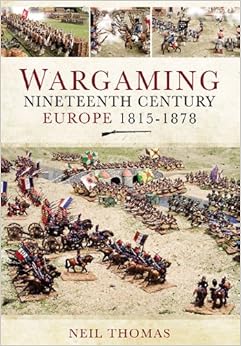
Neil Thomas' Wargaming the Nineteenth Century review


I was looking for a ruleset to use my new Risorgimento figures and my attention was caught by "Wargaming the Nineteenth Century in Europe 1815-1878" by Neil Thomas.


I already heard of him as author of One Hour Wargaming and other works concerning our hobby, but I never dealt with his works.

Since I couldn't find much about the set on the net, I decided to purchase the kindle edition straightly from the publisher (Pen&Sword) at 4.99£. Great value for the money, but...there are no pictures only drawn maps. I know that in the printed edition (19.99£+ shipping) there are several pictures of gaming tables. Anyways, nothing essential. (EDIT: I found the pictures, they are at the very end of the book and not inside it)

The book gives a good historical and military introduction of the warfare in the period and then speculates on the best way to model a wargame to represent it. The process really reminds me Sabin's Lost Battles

The rules per se are just 8 pages (in the printed copy) and are very old style in layout, but the approach is interesting: simpler is better, and so we get a distillation of 19th century warfare. Those looking for detailed rules will be disappointed, but I love easy (yet period-specific) games. The rules are aimed at small battles involving around a brigade per side. They are very simple and should play in about 2 hours, involving about 10-15 units per side. Command and control is included just as optional rule, since "a player is able to act foolishly without external rules"

The rules are completed by 15 army lists, 5 generic scenarios (one mini-game) and 10 historical scenarios covering the main conflicts in Europe from the Carlist War to Franco Prussian War. There is no point system, but an interesting army generator which with a couple of dice rolls generates a casual army.

For the Italian Risorgimento there is only one scenario included (Montebello 1859), but are provided lists for generic revolutionary and monarchic army (1848), French, Italian, Austrian (1859 and 1866), Garibaldini and Bourbonic (1860). There is an error in the rating of Bourboinc troops, in my modest opinion, the author was too influenced by some sources he used. Anyway, this can be solved with some work. With some work a Papal State army can also be produced, and additional historical scenarios, too.

In conclusion: it's not the scale of battles I'm interested in, since I'm going to play the period with 28mm figures and I aim to play a large skirmish kind of game, as Lion Rampant or Sharpe Practice, but I'd steal some idea (best form of adulation, isn't it?) if I ever had to write my own rules.

venerdì 1 settembre 2017

Italian Wars of Unification from Osprey!


Armies of the Italian Wars of Unification 1848-70 (1)
(by Gabriele Esposito; illustrated by Giuseppe Rava)


Last month, Osprey published in its Men-at-Arms collection the first of a two books series about Italian conflicts of XIX century.  

Italian Wars of Unification is a subject always neglected by the international publications, at least from a uniformologic point of view. Of course in Italy it's a more common theme, but it's really cool to start seeing it arising some interest abroad. The Italian Wars of Unification lasted about 22 years and saw the birth of Italy as a Nation. They offers a wide choice of scenarios for wargamers of any nationality. The numbers of factions involved, the many different uniforms (essentially a mix from original Italian design and foreign inspirations) have the potential to please both the warfare and the  estethic lovers.

Of course there is still a lack of appropriate models, but there are some "promising" signals, I will talk about them in a separate post (stay tuned!).

The author, Gabriele Esposito, has done a great job of sinthesis. In fact describing the 1848-49 war as a single war is misleading. There is a proper campaign (Kingdom of Piedmont against Austrian), but there is an insurrection of Sicily (proclaming indipendence from the Kingdoms of the Two Sicilies) and many national uprising, in Rome (Republica Romana), Venice (Repubblica di Venezia) and other cities. So regular armies and volunteers twingles in confusing years. 


Remember: the booklet is the first of two. In this one are described the armies of Piedmont and the Two Sicilies. For both you have a nice (even if schematic) introduction, organisation and different specialities are treated in order (infantry, cavalry corps, engineers, etc...) and then there is a short chapter about weaponry. Comparing it to other Osprey MAA, the uniformology is quite "light". Honestly it'd have been difficult to be more specific with so many troops to treat. Just assume Austrian armies of roughly the same period are treated in two different books (The Austrian Army 1836(1), for infantry and (2) for cavalry) and that's just one Nation! So I appreciate even more the skill of the author to concentrate the informations, many of them added in the description of the pictures inside the text or the plates, painted by Giuseppe Rava, probably the most skillful Italian military painter, compared to Angus McBride himself.


The plates are fantastic, they are a really great added value for the book, historically accurate and characterized by a great vivacity. In addition the booklet features a large number of illustrations and drawing from the period.

The next booklet will be focused on Papal army and volunteers.

My only complaint is about the chronology: the usual introduction about the conflict, more necessary because this is a greatly neglected conflict, has been splitted between the two books, thus in this one only 1848 events are described, the other years will be treated in the second one. I understand the choice from the point of view of the publisher, to respect the number of pages Osprey standard imposes. But this fact made me feel the book some of incomplete. I suppose is something it will be solved when this book will be placed in the shelves next to the second part. Luckily we shouldn't wait too long, I don't remember the publication date, but if I recall correctly should be available in some months time.


All the images are used with consent of G.Rava, taken from his official Facebook page, which I kindly suggest you to follow. The author is at disposition for any request from the Publisher.

PS If you're looking for the Austrians who fought the Italians (Kingdom of Sardinia at the beginning of the period), look for Osprey MAA 323 and 329! So actually we can consider Italian Wars of Unifications from Osprey to form a quadrilogy!

domenica 11 giugno 2017

Card Games!

Today we will have a break from miniature wargaming. Let's talk about card games.
When I was younger (well, I'm barely and adult now anyway), my first games, before diving into wargaming, were collectible card games, as Pokemon, Yu-Gi-Ho, and eventually, at the high school, Magic the Gathering.

I really loved MtG, the mechanics, the setting, the illustrations...but it went quickly expensive: to keep your deck competitive, you had to spend a lot of money and the continuos publication of new expansions (which makes older prints out of standard for tournaments) made me sick. So I had to shut it down.

In the following years, as you may imagine, my attention was entirely drawn by miniature wargames, starting with 15mm ancient wargames (as Impetus and Field of Glory) and continuing with 28mm scale (Lion Rampant, Ronin, Bolt Action, just to name a few).


So I was a bit surprised when my high school friends (who are casual gamers and absolutely not into miniatures games) started to develop an interest in card games. Since I already abandoned  collectible card games, I was not enthusiastic, until I realised I missed a lot of new generation card games, which do not require collection but are complete in their box (except expansions), basically board game without the board!

Now, if I should choose what to do during an evening with my friends, my first choice would be choosing one of our card games and having some games! Of course they require small space for stockage and transport and so they are useful as travel entertainers too!

Playing Munchking in Stockholm hostel last month!

Every game in our collection share the following characteristics:
  • easy to learn: we can't spend an hour to teach a new player how to play
  • easy to play: we want to feel relaxed after a game, it's a sort of after work meeting so everyone is already tired from the working/studying day
  • fun (of course!)
  • short: ranging from 30' (allowing multiple games in a evening) to 1 hours (with one exception): we are meeting during the working week.

And now a quick list of our games, if anyone wish a more detailed description, just ask and I'll provide a full review!


Samurai Sword

It uses the same mechanic as Bang!, bringing them into the Japanese setting. Each player has a secret role (Samurai and Shogun, Ninjas and Ronin) forming up to three different teams, (but you don't know who is your ally and who's your enemy). The game it's pretty simple you must attack the players to kill them and gaining one honour point (each player can respawn a set amount of times in the following turn), when the deck ends or one player reach its respawn limit, the game ends and the team with more honour points wins the game.

3-7 players, about 30'


Exploding Kittens

According to the disclaimer, the most founded game on kickstarter. In this game, drawing is the last action in your turn, and sometimes, in your game. The deck is filled with dangerous exploding kittens, ready to blow you up. If you draw an exploding kittens you die. Of course you can defuse them once (or more if you can steal defuse cards from other players), but they'll eventually blow up in your face! And then it's game over! Only one player will survive! I strongly advice to purchase the expansion Imploding Kittens too, which adds lot of variety to the game.


Ta Pum!

A cooperative game, useful to strenghten friendship, you can only win (or more often loose) all together. You represent a group of friends thrown into the first world war trenches. The missions are awful and only helping each other you can survive the war. The game has a beautiful French comic style of illustrations! (the game is French)

2-5 players, about 30'-1hour


Stay Away

Have you seen "The Thing"? Well, this is a blind game, one player at a certain point of the game will become the Thing and starting infecting the others, you must find him and kill him (via flamethrower). But you must pay attention about who you incinerate, if all the non infected players are removed from the game the Thing team win! There is a lot of bluff in this game, and I advice you to play at least with 5-6 players, but with 10-12 will still work and increase tension (lot of tension in this game, I really like it! I can assure you that will fear the infection (and the flamethrower) and do anything you can to convice other players to have mercy!

4-12 players, 15 to 60 minutes

thanks to Isola Illyon for the image


Munchkin

A parody of Dungeons and Dragons, or fantasy RPG in general. A comic style hidden a nice mechanic with lot of fighting between the players and with the monsters to become the first character to reach level 10 and win the game! A lot of expansions and mods for different settings (for example Munchkin Chtulhu). It can last a bit longer than the other games, let's say 1.5 hour to 3 hours. Can be found here, or in many game shops.

The author playing as a dwarf (nano in Italian)

Ready to Rock

Last, but not the least, Ready to Rock! This game was created by an Italian guy and it really deserves to be known, the game represent a Rock concert, each player has a ticket (his starting point) and must reach the stage, where the band is performing to win the game!
Each turn the player can do two actions, i.e. playing two cards from his hand. There are basically two kind of cards: the path cards, which draw the path you can walk to the stage, and the flash cards, all well themed actions (drinking beer, groupies, etc...). One flash card can make you draw one random the stage card, this separated deck is placed on the stage and represents actions performed by the band which affects all the players. Sometimes can be very counterproductive!


The game is written in English even if it's produced in Italy and in the website you will find a nice tutorial and game aids, there is also a mobile page to be used for advide during the game! (So you doesn't have to ask for the rules booklet).

Players: 3-9
Duration: 20-40 minutes


domenica 23 aprile 2017

A game with Ronin and some thoughts about it


After some months since our last game, yesterday Marco and I played Ronin, a skirmish game by the Osprey wargaming series, written by Craig Woodfield and set during the Sengoku Jidai, litteraly the “Age of warring states”, i.e. the “feudal Japan” or “the age of Samurai”!


It was a project we started last year and we quickly painted up our forces (the started warband, or buntai) can be made up using about five models. Marco chose Samurai, I chose Sohei Warrior Monks, Stefano, Alberto and Edoardo also went Samurai. All our models are from Perry miniatures, except on Reaper Ronin (which is currently having issues with his sword).
For a good review about mechanics read this blog: they explain the game very well.

The two buntai (warbands) (150 points) in our game were: Bushi (i.e. Samurai Faction) and Sohei (Warrior Monks).

Marco's Bushi buntai approching!

Bushi
2 Ashigaru with yari
1 Ashigaru with Yumi
1 Ashigaru with Teppo
1 Samurai with Katana, Intuition, Kenjutsu
1 Hatamoto mounted on Warhorse, Kenjutsu, Bujutsu

Sohei
1 Initiate with Naginata
1 Initiate with Yumi
1 Initiate with Teppo
2 Sohei with Naginata, Naginatajutsu
1 Senior Sohei with Tetsubo, Fast, Poweful


I arrived late at the club, so we could play just 6 turns out of 12.  It was quite a long time since we last played Ronin, so resolving shooting and combat took a bit more time than usual.

We chose a skirmish scenario, and rolled for weather and time of the day heavy mist and night. They both reduce LOS to 12”, so shooting had a small impact in this game, which quickly degenerated into a massive melee in the middle of the battlefield.


A consideration I did when chosing the scenario is that, even if there are 7 scenarios included in the rulebook, but 2 (duel and tournament) are of small interest to me, and another (assassination), though interesting, involves a ninja buntai, with its own special rules and, although historically correct, is to be considered a “special” scenario. So, the basic scenarios for “normal” buntai reduce (to me) to encounter battle, capture and objective, defend an objective, raid/defend a village. I will probably check En Garde! to gain further inspiration.
We also wanted to try how mounted combat works and so spent some time checking on the rules the exact mechanic. Our opinion is that, although the differences between mounted and normal combat are small, they flow elegantly in the general combat mechanic determined by combat pool. The mounted models may perform ride through attack, which at the expense of halving the combat pool of both fighters, allows the riders to move in the combat phase (before and after resolving combat). This add a completely new layer of strategy to the game. Another very lovely nuance is the possibility for assaulted models to choose to attack the horse or the rider.


My general impression is that this set of rules provides some occasions of strategic thinking, sometimes very chess like, but with the random element of the dice rolling. Using more than the basic 100 points, will, however, led to a game not so quick as other skirmish game. We would probably have needed at least a total of 3 hours to end the game with ease. Probably with more experience this time could be considerably reduced (maybe to 2 hours). 

The game was suspended at the middle of the action, but Marco’s retinue lost two models, and I had to models seriously wounded, so any possibility was still open, and for this reason I decided not to have a complete description of the game. I will do one when I’ll have a complete game to describe in detail (excuse the pun).
 

We had a debate during the game: do the stunned counters and light/grievius wounds initiative malus stack or not? It's clearly stated that stunned counters are cumulative, but the model just suffer a -1 for the initiative roll. Any idea? My thought was that yes, they stack, Marco didn't think so.