Visualizzazione post con etichetta 28mm. Mostra tutti i post

sabato 20 dicembre 2025

Back to Bolt Action (3rd edition): an East Africa Battle (1941)

ENGLISH

After some time away from the table, it felt great to dive back into Bolt Action 3rd edition, and what better occasion than an HBA tournament organised by our friends from Treviso. The event was the perfect excuse to roll dice again, in good company and with a special assistance.

For our re-training game, we set up an Italian East Africa scenario (1941): Italian forces against the British. It was a thematic and historically grounded matchup that immediately set the tone for a fun but challenging game. The match itself was tense and well balanced. In the end, the Italians secured the victory, helped by a combination of unlucky dice rolls on the British side and a perfectly placed HE shot from the 75/46 gun, which proved decisive at a crucial moment, almost depleting a fresh British infantry squad close to the objective of the game.

From a gameplay perspective, the battle really highlighted how important historical lists are for balance. Using them made the scenario feel fair and authentic. The Italian player, for example, really felt the historical struggle of facing heavily armoured Matilda tanks with only light anti-tank options, such as the M11/39. It was challenging, but in a good way—exactly the kind of tension you want from a narrative-driven game.

The reworked shooting mechanics in 3rd Edition noticeably sped up the game, keeping the action flowing without unnecessary pauses. The new rulebook also deserves praise: it is well laid out, clear, and easy to consult, which made learning and referencing rules during the match much less disruptive.

Overall, the experience was extremely positive. We had a lot of fun, the rules ran smoothly, and the scenario felt both cinematic and competitive. A big thank-you to the Friends of Treviso for organising the event, hosting, and teaching us!

ITALIAN

Dopo un po’ di tempo lontani dal tavolo da gioco, è stato davvero bello tornare a Bolt Action 3ª Edizione, e quale occasione migliore se non un torneo HBA organizzato dai nostri amici di Treviso. L’evento è stato la scusa perfetta per tirare di nuovo i dadi, in ottima compagnia e con un prezioso supporto durante la partita.

Per questa partita di “ri-addestramento” abbiamo allestito uno scenario di Africa Orientale Italiana (1941): forze italiane contro britanniche. Un confronto tematico e storicamente solido, che ha subito dato il giusto tono a una partita divertente ma impegnativa. Lo scontro è stato teso e ben bilanciato. Alla fine, la vittoria è andata agli Italiani, grazie a una combinazione di tiri di dado sfortunati per il lato britannico e a un colpo HE perfettamente piazzato dal cannone 75/46, risultato decisivo in un momento chiave, arrivando quasi a decimare una fresca squadra di fanteria britannica nei pressi dell’obiettivo di gioco.

Dal punto di vista del gameplay, la partita ha messo in evidenza quanto siano importanti le liste storiche per mantenere l’equilibrio. Il loro utilizzo ha reso lo scenario più equo e autentico. Il giocatore italiano, ad esempio, ha percepito chiaramente la difficoltà storica di affrontare i pesantemente corazzati carri Matilda disponendo solo di limitati mezzi anticarro, come l’M11/39. Una sfida impegnativa, ma nel modo giusto: esattamente la tensione che ci si aspetta da una partita a forte componente narrativa.

Le meccaniche di tiro rielaborate della 3ª Edizione hanno velocizzato sensibilmente il ritmo di gioco, mantenendo l’azione fluida e senza pause inutili. Anche il nuovo regolamento merita un elogio: è ben strutturato, chiaro e facile da consultare, rendendo l’apprendimento e il riferimento alle regole durante la partita molto meno invasivi.

Nel complesso, l’esperienza è stata estremamente positiva. Ci siamo divertiti molto, le regole hanno funzionato senza intoppi e lo scenario è risultato allo stesso tempo cinematografico e competitivo. Un grande ringraziamento agli Amici di Treviso per l’organizzazione, l’ospitalità e per averci fatto da “maestri”!


GALLERY


Italian infantry moving to the objective

Italian Askari unit cautiosly advancing 

the Italian light mortar, who duelled with the British sniper (losing at the 5th turn)


one of the protagonist of the day: the mighty Italian 75/46 AT/AA gun

two M11/39 blocking the British advance towards the objective (but failing to disable British armoured forces)

Matilda mkII and British troopers


mercoledì 17 settembre 2025

Byzantine encircled - a scenario from A Viking in the Sun

Last night was the inaugural game for Luca’s new Byzantines against my Normans in 11th-century Southern Italy. 


 The scenario we played was “Massacre by the River Olivento”, taken from A Viking in the Sun, an expansion of the Lion Rampant ruleset by the History & Games Lab at the University of Edinburgh, led by Dr. Gianluca Raccagni and dealing with Hardrada deeds around the Mediterranean before the Crusades. In the game, the Byzantines had to escape across a river while pursued by Norman forces. 

After several cavalry clashes in which the heavier Normans, supported by archers, routed the Byzantine duke and his koursores, the Varangians broke the encirclement, eliminated the Norman commander, and opened a gap that allowed the rest of the Byzantine troops to escape the trap. Norman infantry followed the enemy, but tired from the long pursuit, failed the last-moment charge. It was a hard-fought battle with a fun and original scenario, ending in a 6-4 victory for the Byzantines.


sabato 14 giugno 2025

Report – Evento “Gioca La Storia” | 8 Giugno 2025

 🇮🇹 (English Below)

L’8 giugno abbiamo partecipato con grande entusiasmo all’evento Gioca la Storia, tenutosi presso il Museo delle Forze Armate 1914-1945 di Montecchio Maggiore. In questa splendida cornice, ricca di reperti storici di grande valore (che meriteranno un post a parte), diverse associazioni e gruppi di wargame storico tridimensionale provenienti da tutto il Veneto hanno allestito tavoli dimostrativi per far conoscere al pubblico il mondo del wargame e il suo valore educativo nella simulazione e nello studio della storia militare. 

Durante la giornata si è giocato con regolamenti ambientati nella Prima e Seconda Guerra Mondiale, tra cui: Bolt Action (scala 28 mm), Schutzengruppe (scala 1/72), Flames of War (scala 15 mm), Lacquered Coffins (scala 1/300, aviazione WWII) e Blue Max (WWI, gioco aereo).

La partecipazione del pubblico è stata ottima, con particolare entusiasmo da parte dei più piccoli, attratti in modo speciale dal tavolo di Bolt Action.


28 mm Bolt Action, First Don offensive game


Tobruk 1942 with Bolt Action (28 mm)

Italian and British fight over the Mediterranean sea

Sono state allestite anche vetrinette didattiche per illustrare “gli attrezzi del mestiere” dei wargamer!

Some pictures from the exhibition

Non vediamo l’ora di poter replicare questa bellissima esperienza con una seconda edizione! Vogliamo in particolare ringraziare il direttore del museo Stefano e tutti i volontari del museo per la bellissima opportunità, Enrico e Lorenzo, degli "Amici del Modellismo Treviso", "Il Circolo di Pietra" e gli amici di Bassano del Grappa (Maurizio in primis).


Avanti Savoia! 28mm Italian cavalry in the Steppe (Bolt Action)

Biplanes fight! 1/300 H&R planes game with Lacquered Coffins

Tobruk 1942 


SM79 lands a torpedo which blows the British cruiser


EN

On June 8th, we enthusiastically took part in the Wargame at the Museum event, hosted at the Museo delle Forze Armate 1914-1945 in Montecchio Maggiore. In this beautiful and historically rich setting, various wargaming clubs and associations from across the Veneto region presented tabletop simulations to showcase the educational and historical value of miniature wargaming.

Several gaming tables focused on World War I and II scenarios, featuring: Bolt Action (28 mm scale), Schutzengruppe (1/72 scale), Flames of War (15 mm scale), Lacquered Coffins (1/300 scale, WWII air combat), and Blue Max (WWI aerial dogfights).

Educational displays highlighted the tools and materials used by wargamers, and the museum staff ensured excellent organization – we thank them warmly for their support and hospitality.

The event was well attended, with many children especially captivated by the Bolt Action table.

We are already looking forward to the second edition of this fantastic event!


giovedì 13 marzo 2025

Lion Rampant at Lazise Gioca: A Medieval Skirmish on Lake Garda

This past weekend, we had the pleasure of attending Lazise Gioca, a fantastic gaming convention held in the scenic town of Lazise, on the banks of Lake Garda (Verona, Italy). Among the many tabletop and board game offerings, we set up a historical wargaming table featuring Lion Rampant by Osprey, a fast-paced and engaging skirmish game perfect for conventions.

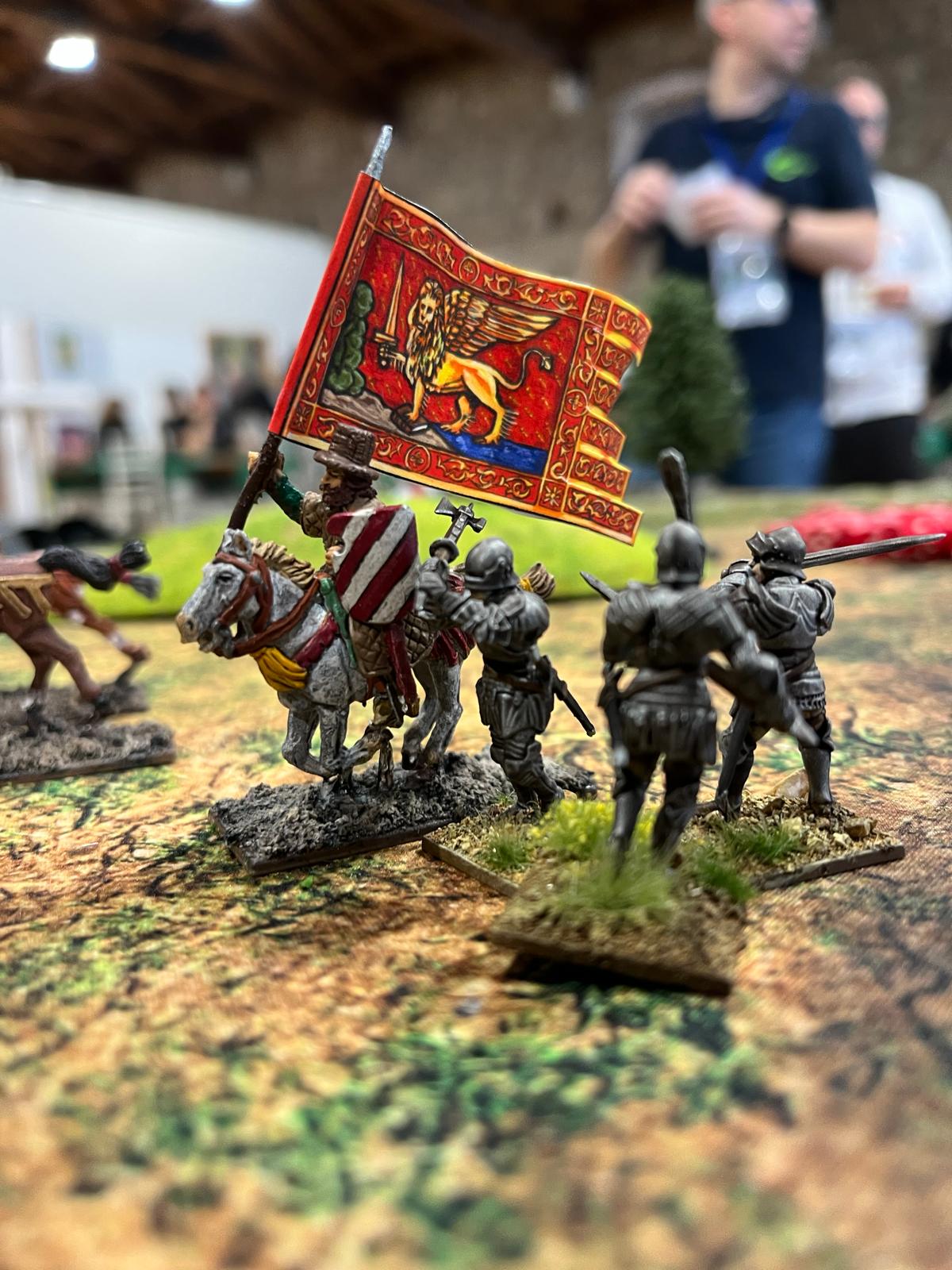
Since the lake Garda was a border region between Milan and Venice, we decided to bring two condotte  from the late 15th century: one representing Milan and the other Venice. Each force was built to the standard 24-point size, constructed mainly from Perry's plastic miniatures. Throughout the day, we managed to run two different scenarios.

The Battles

Our first scenario was Bloodbath, a straightforward clash where both sides sought to eliminate the other through sheer force of arms. It was a brutal and fast-paced engagement, with both condotte trading blows in a display of tactical maneuvering and daring charges. Despite the famed resilience of Venetian forces, the Milanese emerged victorious, securing a hard-fought win.

Next, we set up The Fugitive, a scenario centered around capturing (or rescue) a key figure hiding on the battlefield. The Milanese, emboldened by their earlier success, pressed the attack relentlessly and managing to free the prisoner. Once again, Milan’s condotta claimed victory!

A Great Experience

The event was a fantastic opportunity to showcase Lion Rampant and introduce new players to the world of historical wargaming. The game’s elegant mechanics and accessible rules made it a hit among both casual visitors and experienced gamers alike.

Overall, Lazise Gioca proved to be a fantastic convention, in an amazing setting, and we thoroughly enjoyed bringing late medieval Italy’s mercenary battles to life. 

Milanese foot men at arms fight Venetian stradiotti

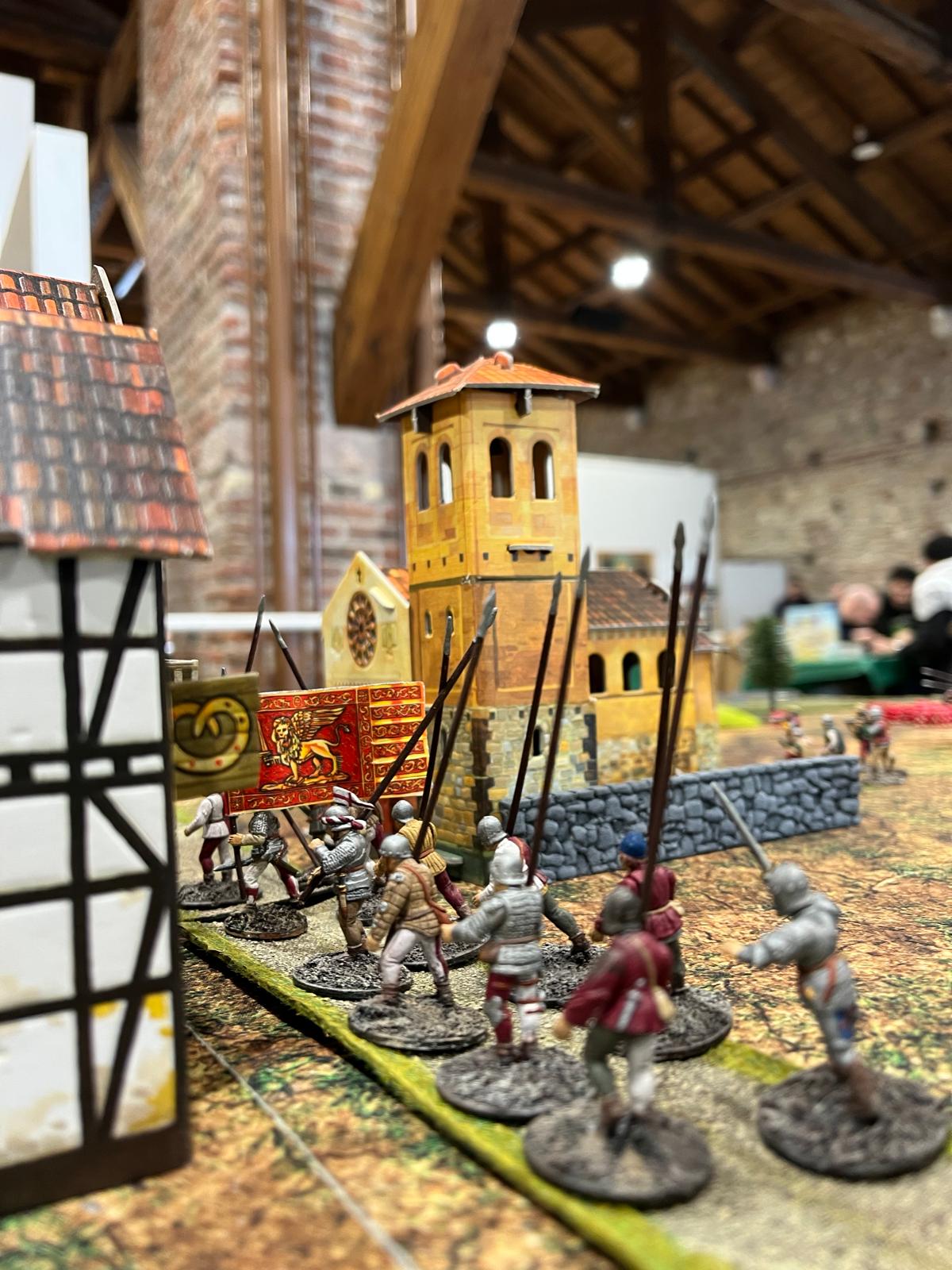
The setting

The Venetian Cernide (foot yeomen in the ruleset) enter the village

The Heavy Cavalry clashes!

Milanese Crossbowmen: one of the major contributors to Milanese's victory

Stradiotti tries to held the line against the heavier Milanese's Lance Spezzate

Venetian Schioppetti are mauled by Milanese dismounted knights


lunedì 10 marzo 2025

The Battle of Messeburg, 1632


The Thirty Years' War has been ravaging Germany for years. Over the past winter, Swedish King Gustavus Adolphus skillfully employed diplomacy to strengthen the Protestant coalition, securing new allies against the Catholic Imperial forces. In particular, the Dutch Republic officially joined the war, bringing much-needed financial support and reinforcements to the campaigning Swedish army. 

At the beginning of spring, the Protestant army marched south, prepared to confront the Imperial forces. The Imperials, determined to halt their advance, moved to intercept. Their armies would soon meet near the bustling market town of Messeburg, where a decisive battle loomed.


Initial Deployment

The Swedish army took position between the river and the village of Messeburg, anchoring its right flank with Protestant allied regiments of Dutch and Scottish troops under General De Vere, supported by dragoons commanded by Justinus von Nassau. The Swedish left flank was held by the cavalry, while in the center, a small reserve under Åke Tott stood behind the main infantry line.

The Imperial forces deployed strongly on their left flank, concentrating veteran tercios and their best marksmen in this sector. Their right flank, composed of heavy cuirassiers, was positioned beyond the river, seemingly preparing for an outflanking maneuver.


Early Skirmishes on the Left Flank

To counter the Imperial commanded shot in the wooded area on the Swedish left, the Dutch commander sent his mounted arquebusiers into the forest. However, their horses struggled with the rough terrain, and the Imperial troops managed to penetrate the woods, forcing the Dutch skirmishers to fight defensively with little success.


Stalemate in the Center and Right Flank

For much of the morning, the rest of the battlefield remained quiet. The Imperial troops stayed out of range of the Swedish artillery, while the Imperial cuirassiers on the right bank of the river showed no immediate intention of crossing. The Swedish cavalry took position on the opposite bank of the river, ready to strike if the enemy attempted to ford the waters.


Fierce Fighting for Messeburg

At the center of the battlefield, a brutal contest erupted for control of Messeburg village. Dragoons and commanded shot on both sides engaged in bloody street fighting, with the village changing hands multiple times. Only by the end of the day did the Swedish forces secure firm control over the settlement.

Åke Tott’s Failed Charge

Noticing a gap between the Imperial center and left flank, General Åke Tott led a squadron of demicuirassiers in a daring charge against the Imperial artillery. Despite initial success, the assault was repelled, and the Swedish cavalry was chased down by a squadron of Imperial dragoons hastily redirected from the fight in the village, momentarily relieving pressure on the besieged Protestant regiments.


Crisis on the Swedish Right

Meanwhile, on the Swedish right flank, the Dutch and Scottish mercenary battalions came under severe artillery fire, soon followed by volleys from the advancing Imperial tercios. Exposed in the open, the Protestant regiments suffered terrible casualties and began losing cohesion.


Gustavus Adolphus Takes Action

Realizing the precarious state of his right flank, King Gustavus Adolphus decided to order an advance of his Swedish infantry to stabilize the situation. The disciplined Swedish musketeers slowly moved into firing range, preparing to pressure on the Imperial right flank.


Imperial Assault on the Dutch and Scottish Regiments

Sensing the weariness of the Swedish right flank, the Imperial forces launched a full-scale assault on the battered Dutch and Scottish regiments. Despite their determination, the Protestant mercenaries suffered horrendous losses but held their ground at great cost, momentarily halting the advance, but on the brink of collapse.


Swedish Cavalry’s Bold River Crossing

In a desperate attempt to turn the tide, Gustavus Adolphus ordered his elite Swedish cavalry to ford the river and strike the Imperial right flank. The Imperial cuirassiers were caught off guard, and one squadron was routed at significant cost. However, the fighting along the river remained inconclusive, and the Swedish forces could not fully exploit their success due to the disarrangement they come after the perilious crossing.


Collapse of the Swedish Right Flank

Under relentless pressure, the Swedish right flank finally began to crumble, with two regiments breaking and fleeing. The Imperial forces pushed forward, threatening to roll up the entire Swedish line.


Tott’s Decisive Rear Attack

Meanwhile, Åke Tott regrouped his cavalry in the Imperial rear, having defeated the Imperial dragoons. He then launched a decisive charge into the rear of a struggling Imperial tercio, which was already wavering under fire from the elite Swedish Yellow Regiment.


Battlefield Stalemate

As the sun set, the battlefield was in a state of deadlock. The Swedish right flank was shattered, incapable of further combat. However, a significant gap had been opened in the Imperial center, with Messeburg in Swedish hands, effectively splitting the Imperial army in two. On the left flank, the battle between the opposing cavalry forces remained inconclusive, although reserves were still available to the Catholics. Although numerically disadvantaged and suffering heavier losses, the Swedish forces and their Protestant allies maintained control of the field and withdrew in good order, denying the Imperials a clear victory. The battle ended in a costly stalemate, with both sides bloodied and exhausted.


Final Comment

We played this game at Model Expo 2025 Convention in Verona with Liber Militum Tercios, 2000 points per side, 2 vs 2 players, in a 240 x 180 cm table! The game played smoothly over 5 hours. The Imperial ended with 2 points of advantage, which were not enough to declare a clear victory. Overall, we enjoyed the experience and many people stopped to ask and take pictures!

sabato 11 gennaio 2025

The First Battle of the Year – The Ottomans arrive!

 Hello fellow wargamers! The first battle of the year marked the debut of my "new-old" Ottoman army. The miniatures are primarily from Old Glory 25s, originally purchased back in 2018 for Lion Rampant. They represent a slightly earlier period (late 15th to early 16th century), but I think they work well enough for the mid-17th-century setting of Liber Militum: Tercios. Sure, they may be a touch antiquated for the era, but the effect on the table was nice nonetheless.

1635, January – Austro-Hungarian Border

Under the frostbitten skies of a bitter January, Gri Bozkurt Pasha—“The Grey Wolf,” an ambitious Ottoman commander, set out to make his mark. Recently promoted and eager to prove himself, the Pasha led his army across the borderlands into the territories of the Holy Roman Empire. With limited time and resources, his force lacked its usual complement of cavalry. Instead, he relied on the professional discipline of his Janissaries, generously assigned to him by the Grand Vizier, and a modest cavalry contingent.

The Imperial response was swift. The local commander, pressed for time and men, assembled a smaller but experienced force to intercept the invaders. The two armies met on a cold plain where Ottoman artillery and Imperial tercios squared off across open ground. On the Ottoman right, the cavalry prepared for their pivotal role in the battle.

The opening moves unfolded on the Ottoman right, where the cavalry began their engagement. After an initial exchange of volleys, the Sipahi [medium to heavy cavalry, the backbone of Ottoman mounted warfare, known for their discipline and shock potential] charged the Imperial mounted arquebusiers. Though the arquebusiers attempted to evade repeatedly, they were eventually forced into a pitched fight. Meanwhile, the Akinci [light, swift raiders, adept at skirmishing and harassment] harassed the Imperial cuirassiers, tying them up for the entire battle. Though the Akinci suffered losses, their efforts ensured that these elite Austrian units never threatened the main Ottoman forces.

In the center, the infantry lines closed with grim determination. Artillery fire from both sides disrupted formations, but neither side faltered. The Janissaries and Imperial tercios engaged in a brutal war of attrition. While the Ottoman leadership lacked decisiveness, the discipline of the Janissaries kept them holding the line against repeated Christian assaults. The skirmishing azap units added to the pressure, exploiting their numbers to outmaneuver and harass the slower tercios.

As twilight descended, the weight of Ottoman arquebus and bow fire proved too much for the beleaguered tercios. Disordered and depleted, they began a fighting retreat, ceding the field to the Ottoman invaders.

The battle concluded with a decisive victory for Gri Bozkurt Pasha. Though his army bore the scars of the encounter, the Imperials were left shattered, and the path was clear for the Pasha’s forces to plunder the surrounding lands.


Conclusions

Overall the game was fun, the Ottomans were an exotic army with different tactical challenges compared to traditional European forces. Their line infantry is less effective individually, but their lower cost allows for numerical superiority, which can provide a strategical advantage due to the turn structure of Liber Militum: Tercios. Obviously new unit are going to be recruited (i.e. bought) soon.


Campaign

This was the first battle of our yearly campaign, which will connect all our games of Tercios and The Pikeman’s Lament into a shared narrative.  The exact rules are yet to be decided, but at the moment we will take note that a small Imperial force has been depleted by a Turkish incursion and we will let you know how this will reflect in the overall score of the campaing (probably this will be a separated southern front with its own score).

domenica 3 marzo 2024

Journey to the City of the Damned

After more than one year, I am posting here again.

With a couple squadrons for Lacquered Coffins and a Bolt Action/Crossfire army almost completed (more in future posts), let me introduce you to my next project: a Cult of the Possessed Warband for Mordheim.

This is my first time painting a fantasy army since I am mainly a historical wargamer. However, due to some unforeseeable combination in my recent life,  I have the occasion to play Mordheim. Its setting, lore, and grimdark appearance have always fascinated me.

I bought a Frostgrave Cultist plastic box for this project, which is fantastic value for money. Additionally, I ordered some bits from Crooked Dice to convert my miniatures and represent mutations. My Magister, Possessed, and Beastmen are also from Crooked Dice.


It sounds like the first step toward a long downward journey to the City of the Damned. Stay tuned.


sabato 10 settembre 2022

Learning Crossfire

As one of the most iconic conflicts in history, the second world war (WW2) is probably one of the most played periods in the wargaming landscape.

For players interested in 28 mm large skirmish battles, the main ruleset is obviously Bolt Action, even if a myriad of other sets is available on the market (and many more are free). Last evening we tried Crossfire, which lurked our attention with its focus on infantry and its no-fixed turns approach. Only a few tweaks were necessary to convert the game from a Company-level to a Platoon-level.  Overall the game is very lite, but we keep it basic being the first game, the game flew very well and quite impredictably. In short, we had great fun.

Here are some pictures of our first game, featuring Italian against Commonwealth and Ethiopians in the East Africa Campaign (a post about my Italian Army in Italian East Africa will follow).